
November 15, 2025

Patient Summary
Hazel, 8-year-old female desexed Border Terrier
Service: Abdominal ultrasound
Patient Background & Presentation
Hazel presented acutely unwell, quiet, nauseous, off her food, and vomiting. Bloodwork revealed a marked hepatopathy, accompanied by an inflammatory leukogram and elevated C-reactive protein. On examination, she was dehydrated, painful in the cranial abdomen, and noticeably dull, raising strong suspicion for a focal inflammatory process.
The clinical question was whether there was a specific source of abdominal inflammation, particularly involving the liver or biliary system. Given the rapid progression of signs, an urgent veterinary abdominal ultrasound was arranged to help determine the cause and guide management without delay.
Ultrasonographic Assessment & Findings
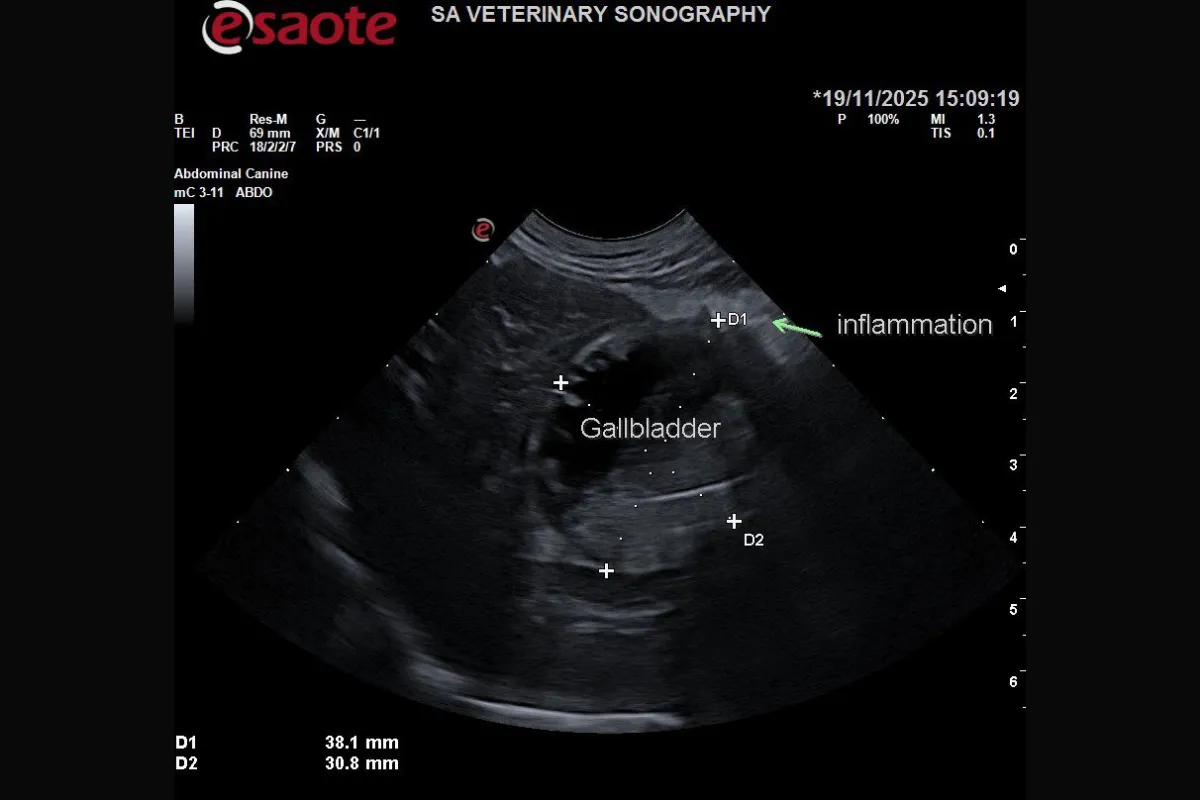
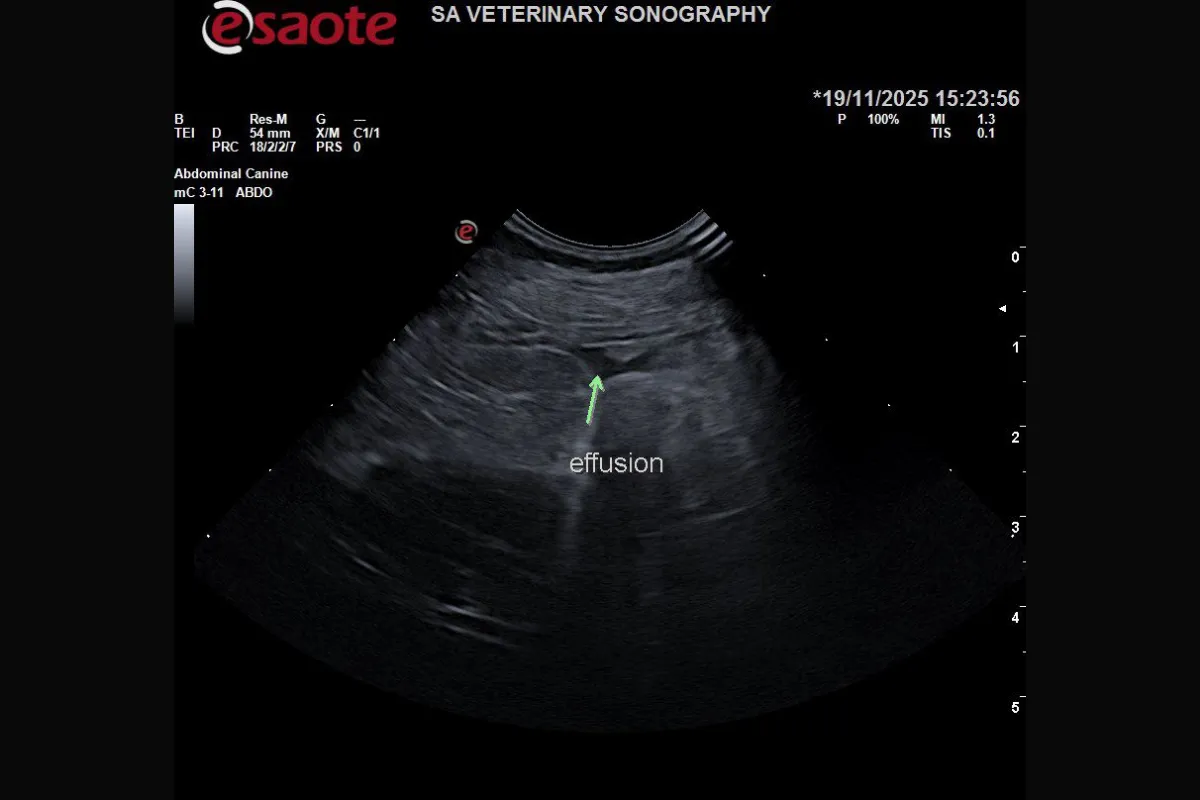
Ultrasound revealed extensive inflammation in the cranial abdomen, with hyperechoic, hazy fat and reduced acoustic detail. A small volume of echogenic effusion surrounded the area.
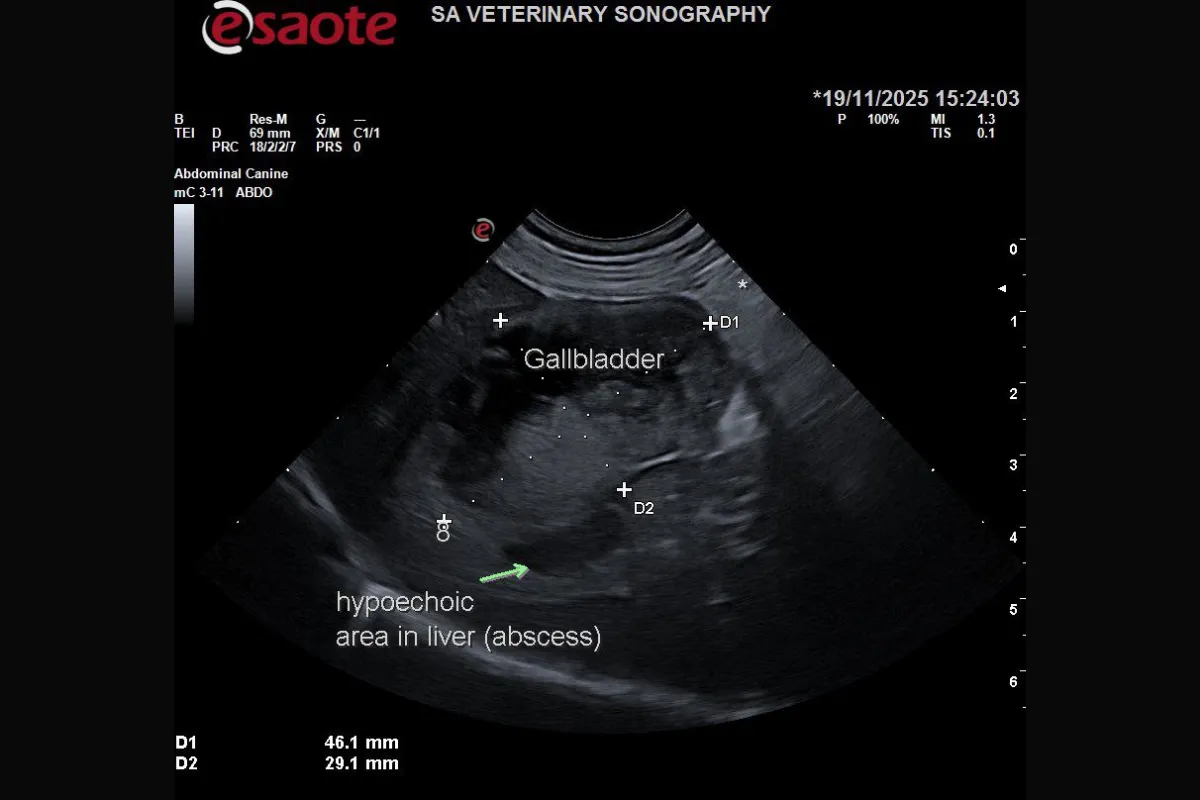
The gallbladder was severely abnormal: distended, thick-walled, and containing a mix of organised and motile sludge. Significantly, a gas artefact was visible arising from the gallbladder wall, an alarming finding consistent with emphysematous cholecystitis, a life-threatening infection that risks rupture and fatal peritonitis. Adjacent to the gallbladder, a poorly defined hypoechoic lesion within the liver suggested a possible abscess.
These findings confirmed a severe gallbladder infection, likely associated with an atypical form of mucocele despite the absence of the classic kiwi-fruit pattern.
Diagnostic Impact & Case Management
A sample of the abdominal effusion collected via abdominocentesis confirmed septic peritonitis, without evidence of bile. Combining peritonitis, emphysematous changes, and a suspected liver abscess, emergency surgery became the clear next step.
Hazel underwent a cholecystectomy, and the abscessed liver segment was removed. The prompt diagnosis made possible by in-clinic imaging for SA vets enabled clear communication with the owner and rapid progression to surgery – essential in conditions where delays significantly increase mortality risk.
Outcome & Follow-Up
Hazel recovered extremely well postoperatively. The findings supported the suspicion that a variant of biliary mucocele had initiated the infection, serving as an important reminder that gallbladder mucoceles exhibit a wide spectrum of appearances in dogs.
Follow-up imaging was not required due to Hazel’s excellent clinical recovery. For SA clinics, especially in regional areas, mobile ultrasound support in Adelaide can be critical for early differentiation of hepatobiliary disease and for guiding the urgency of surgical intervention.
Vet Collaboration & Communication
The referring vet coordinated the case efficiently, engaging ultrasound early and enabling seamless communication before and after imaging. Collaboration with SA Veterinary Sonography allowed a rapid transition from diagnostic uncertainty to decisive surgical planning, significantly improving Hazel’s outcome.
Key Learnings for SA GPs
- Gallbladder mucoceles are not always classic in appearance – atypical presentations can still behave aggressively.
- Gas in the gallbladder wall is an emergency finding and should prompt immediate surgical consideration.
- Veterinary abdominal ultrasound SA is the fastest way to differentiate inflammatory, infectious, and obstructive hepatobiliary disease.
Early access to mobile ultrasound Adelaide services can be invaluable for clinics managing unstable cranial abdominal pain cases.
If you’re working through a similar case or would like imaging support, we’re always happy to assist.
About the Author
Dr Jennifer Judd BVMS GCertSAUA MANZCVS (Radiology) is a visual thinker and ultrasound devotee with a knack for turning complex scans into practical answers. After a decade in general practice, she founded SA Veterinary Sonography to bring precision imaging into the hands of everyday vets.
Dr Jen is known for her calm presence, sharp eye, and collaborative style – helping clinics navigate tricky cases without sending patients offsite. When in doubt, she’s your diagnostic sounding board.

Mobile Veterinary Ultrasound Services
Advanced in-clinic ultrasound for accurate diagnosis and treatment planning, delivered through abdominal, thoracic, cardiac and reproductive imaging.

Abdominal
Comprehensive abdominal imaging assessing organs, effusion, masses, inflammation, and gastrointestinal changes.

Thoracic
Targeted thoracic ultrasound evaluating pleural effusion, lung changes, and masses, ideal for unstable or dyspneic patients.

Echocardiogram
Detailed cardiac imaging assessing structure, chamber size, function, and mitral valve disease staging for informed treatment.

Reproductive
Focused urogenital imaging assessing pregnancy, pyometra, prostatic changes, urinary tract issues, and suspected bladder stones.
Abdominal
Comprehensive abdominal imaging assessing organs, effusion, masses, inflammation, and gastrointestinal changes.
Thoracic
Targeted thoracic ultrasound evaluating pleural effusion, lung changes, and masses, ideal for unstable or dyspneic patients.
Echocardiogram
Detailed cardiac imaging assessing structure, chamber size, function, and mitral valve disease staging for informed treatment.
Reproductive
Focused urogenital imaging assessing pregnancy, pyometra, prostatic changes, urinary tract issues, and suspected bladder stones.
Frequently Asked Questions
When should I consider a gallbladder ultrasound for a dog with an infection, such as Hazel’s?
Consider an ultrasound when a dog presents with cranial abdominal pain, hepatopathy, vomiting, or systemic inflammation. A gallbladder infection dog ultrasound helps identify emphysematous cholecystitis or atypical mucoceles early. Rapid imaging is especially valuable for SA vets managing acutely unwell patients.
Can gallbladder mucoceles be atypical on ultrasound, and how do I recognise them?
Yes, many mucoceles do not display the classic kiwi-fruit pattern taught at vet school. An atypical gallbladder mucocele on ultrasound may show sludge, wall changes, or signs of secondary infection. Any gas within the gallbladder wall warrants emergency surgical consideration.
How helpful is an abdominal ultrasound for dogs with suspected septic peritonitis?
Ultrasound is one of the fastest tools for detecting septic peritonitis in dogs, allowing vets to assess effusion character, inflammatory fat, and biliary involvement. It guides timely sampling and surgical decision-making. Early imaging prevents delays that significantly impact outcomes.
When should I refer for emergency surgery in cases of severe biliary disease?
Signs such as gas in the gallbladder wall, marked inflammation, or suspected liver abscess strongly support urgent intervention. In-clinic imaging for vets provides clarity on when conservative care is no longer appropriate. Once emphysematous cholecystitis is identified, surgery should not be delayed.
Is mobile ultrasound Adelaide appropriate for unstable dogs with abdominal pain?
Yes, SA Vet Sonography’s mobile ultrasound in Adelaide supports rapid assessment without requiring the transportation of compromised dogs to another facility. This is especially useful for regional or house-call vets managing unstable cranial abdominal pain. Early diagnosis helps streamline referral and surgical planning.
Can an abdominal pain ultrasound differentiate between a liver abscess, gallbladder infection, and pancreatitis?
A targeted abdominal pain dog ultrasound can often distinguish between hepatobiliary, pancreatic, and gastrointestinal sources of inflammation. In Hazel’s case, imaging identified gallbladder infection and a liver abscess, which altered the clinical plan immediately. Ultrasound remains the most efficient first-line modality for SA vets facing unclear abdominal presentations.