
December 15, 2025

Patient Summary
Buddy, 1-year-old male desexed Labrador
Service: Abdominal ultrasound for suspected intestinal obstruction
Referring vet: General practice clinic (urgent same-day request)
Patient Background & Presentation
Buddy was the sort of Labrador who usually bounded into the clinic with full-body enthusiasm, but on this particular morning, he arrived subdued, head lowered, and stomach tight. He had been vomiting repeatedly despite maropitant, and his refusal to eat was especially concerning for a dog (who ordinarily inhaled meals!)
The referring vet noted persistent vomiting, inappetence, mild abdominal pain and growing lethargy. With anti-emetics failing, the question became familiar but urgent:
Is this gastro, or is something obstructed?
Because the clinic needed clarity quickly, they contacted SA Veterinary Sonography for an urgent abdominal ultrasound for suspected intestinal obstruction. For foreign body cases, early visualisation often determines whether the patient stabilises or spirals while you search for answers.
Ultrasonographic Assessment & Findings
When the sonography team arrived, Buddy was stable and cooperative, though clearly uncomfortable. The referring vet had already framed the clinical question around one priority: “Is there a gastrointestinal obstruction, and if so, where exactly is it?”
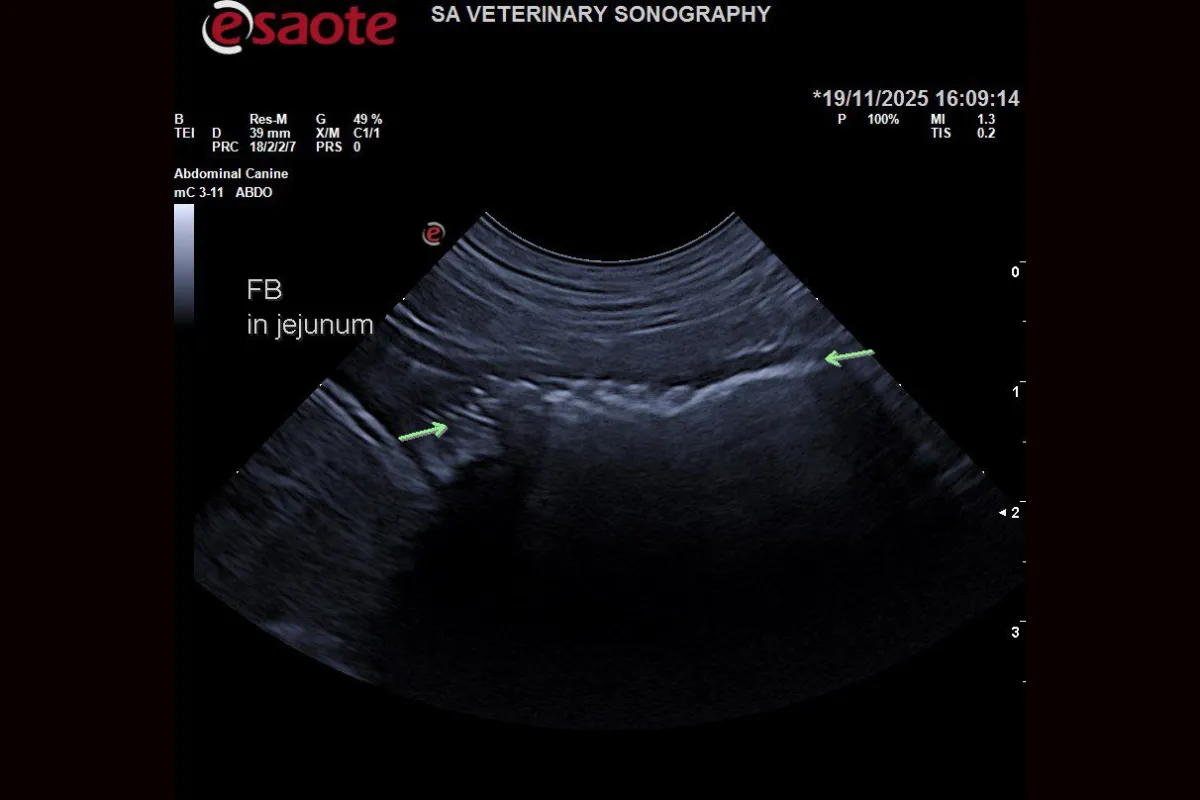
A focused abdominal ultrasound was performed, and the findings were decisive:
- A strongly shadowing object was lodged in the small intestine (jejunum).
- A clear obstructive pattern was present, with a dilated intestine proximal to the object and a normal intestine distal to it.
- No free abdominal fluid or complicating features were noted.
The scan confirmed the obstruction and identified its precise location, providing the vet with immediate and actionable information.
Recommendation: Proceed to surgery.

Diagnostic Impact & Case Management
The ultrasound findings allowed the clinical team to move from suspicion to certainty within minutes. With obstruction confirmed and localised, the vet was able to:
- Prepare for surgery without hesitation
- Refine the surgical approach
- Communicate a clear plan to Buddy’s owners
- Avoid unnecessary delays or exploratory guesswork
This is a textbook example of how collaboration works:
The vet remains the case leader, and SA Veterinary Sonography provides the diagnostic clarity to support rapid, confident action.
Buddy was taken to surgery shortly after the scan, without losing critical time.
Outcome & Follow-Up
Surgery confirmed the obstructive foreign body, which was removed successfully. Buddy recovered quickly, and by the next day, he was back to eating and behaving like his usual, cheerful self. No further vomiting occurred, and no follow-up imaging was required.
Key insight for other vets:
In the hands of experienced professionals, abdominal ultrasound is a highly efficient, minimally invasive, and reliable tool for diagnosing gastrointestinal foreign bodies. It can save time, reduce unnecessary radiographic cycles and clarify the surgical plan early.
Vet Collaboration & Communication
The clinic initiated the case by calling for an urgent scan. Communication remained tight and efficient:
- The vet provided history and concerns.
- SA Vet Sonography confirmed availability and attended promptly.
- Findings were discussed immediately.
- Surgery proceeded without delay.
The vet later noted that having the exact location of the obstruction before entering surgery made the procedure smoother, the decision-making clearer, and the overall experience less stressful for everyone involved, including Buddy’s family. Cases like this highlight how early ultrasound clarity can support confident, well-timed intervention in busy general practice.
If you’re working through a similar case or would like a second opinion on a suspected obstruction, we’re always happy to discuss the options or arrange in-clinic imaging.
About the Author
Dr Jennifer Judd BVMS GCertSAUA MANZCVS (Radiology) is a visual thinker and ultrasound devotee with a knack for turning complex scans into practical answers. After a decade in general practice, she founded SA Veterinary Sonography to bring precision imaging into the hands of everyday vets.
Dr Jen is known for her calm presence, sharp eye, and collaborative style – helping clinics navigate tricky cases without sending patients offsite. When in doubt, she’s your diagnostic sounding board.

Mobile Veterinary Ultrasound Services
Advanced in-clinic ultrasound for accurate diagnosis and treatment planning, delivered through abdominal, thoracic, cardiac and reproductive imaging.

Abdominal
Comprehensive abdominal imaging assessing organs, effusion, masses, inflammation, and gastrointestinal changes.

Thoracic
Targeted thoracic ultrasound evaluating pleural effusion, lung changes, and masses, ideal for unstable or dyspneic patients.

Echocardiogram
Detailed cardiac imaging assessing structure, chamber size, function, and mitral valve disease staging for informed treatment.

Reproductive
Focused urogenital imaging assessing pregnancy, pyometra, prostatic changes, urinary tract issues, and suspected bladder stones.
Abdominal
Comprehensive abdominal imaging assessing organs, effusion, masses, inflammation, and gastrointestinal changes.
Thoracic
Targeted thoracic ultrasound evaluating pleural effusion, lung changes, and masses, ideal for unstable or dyspneic patients.
Echocardiogram
Detailed cardiac imaging assessing structure, chamber size, function, and mitral valve disease staging for informed treatment.
Reproductive
Focused urogenital imaging assessing pregnancy, pyometra, prostatic changes, urinary tract issues, and suspected bladder stones.
Frequently Asked Questions
Can an ultrasound diagnose an intestinal obstruction in dogs?
Yes. In the hands of experienced professionals, abdominal ultrasound can identify obstructive patterns, locate foreign bodies, and assess bowel wall condition, often before radiographs reveal abnormalities. For Adelaide and regional SA clinics, having these answers available in-clinic through SA Veterinary Sonography can significantly reduce delays in care.
When should I request an ultrasound for a vomiting dog?
Ultrasound is recommended when vomiting persists despite treatment, when abdominal pain is noted or when radiographs are normal but clinical suspicion remains high. SA Veterinary Sonography provides same-day, in-clinic imaging for South Australian vets, helping you clarify cases that don’t quite add up.
Does ultrasound replace X-rays for GI obstruction?
No. Radiographs reveal gas patterns and radiopaque material, while ultrasound detects non-radiopaque objects (such as wood, fabric, and rubber) and provides tissue detail. The most complete assessment often comes from using both modalities. SA Veterinary Sonography works alongside your radiographic findings to answer the “is something obstructed, and where?” question.
How does mobile ultrasound support urgent GI cases in SA?
Mobile ultrasound brings rapid, high-resolution imaging directly to your clinic, reducing transport stress for patients with painful conditions and avoiding referral delays. For time-sensitive cases, such as suspected obstruction, SA Veterinary Sonography provides immediate feedback, allowing you to move confidently toward surgery or stabilisation.
Do patients with foreign bodies usually require sedation for ultrasound?
Many dogs tolerate abdominal ultrasound well without sedation. Mild sedation may help if the patient is in pain, anxious or reactive, but many stable patients can be scanned comfortably. Sedation remains at the discretion of the referring vet, with SA Veterinary Sonography adapting the examination to the patient’s comfort and safety.
How does SA Veterinary Sonography support decision-making for GI obstruction cases?
By confirming whether an obstruction is present, identifying its exact location and assessing for complications, SA Veterinary Sonography helps Adelaide and regional SA vets plan surgery confidently and communicate clearly with owners. The service supports your workflow without taking the case off your hands.